Independent Research
Menopause, Estrogen, and the Neuroendocrine Axes
In the 2025-2026 academic school year, I had the opportunity to investigate neuroendocrine processes responsible for symptom ambiguity across menopause and thyroid disease.
Through the River Hill High School Independent Research Program, I designed a descriptive mixed-methods survey to better understand women’s (aged 15-60) endocrine education, gaining 51 responses. Furthermore, I conducted three professional interviews with hormone specialists and healthcare workers. Together, this data strengthened my review of literature, titled, "Estrogen and the Neuroendocrine Axis: Reinventing Women’s Approach to Menopause and Thyroid Disease”. This piece recognized intersections of the hypothalamus-pituitary-thyroid (HPT) and hypothalamus-pituitary-ovary (HPO) axes, symptom manifestation, and clinical approach.
Under the advisement of Dr. David Levitt (Endocrinologist, Maryland Primary Care Physicians, LLC), I designed an educational website The Meno Initiative. This site was structured to guide readers through the hormonal processes behind common symptom overlap; it begins with general menopause education, and ends with an explanation of the hypothalamus-pituitary axes. Finally, it defines thresholds of intervention, outlining certain symptom characteristics that may indicate that both conditions are present.
Ultimately, I hope that my findings prosper questions, discussions, and discoveries in female neuroendocrine function, improving women’s understanding and approach to the midlife transition.
Hypothalamus-Pitutary Signaling Channels
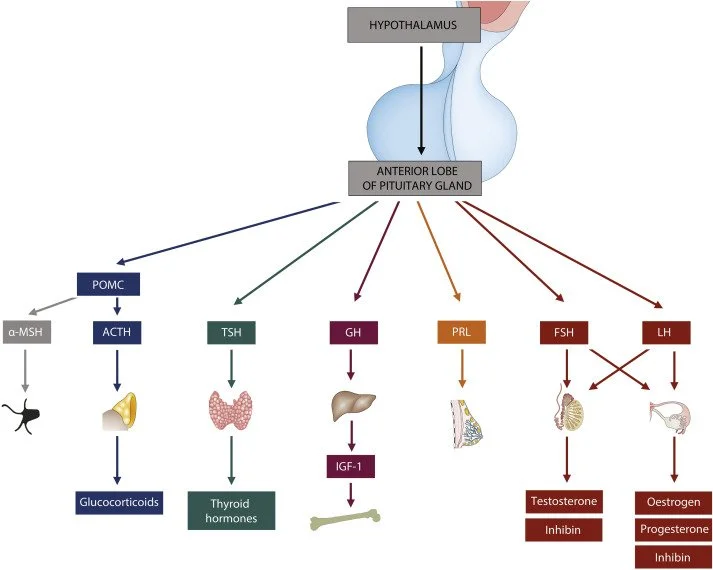
Source: Feldt-Rasmussen et. al
Cross-Variable Comparison: “Menopause Familiarity” vs. Info. Sources
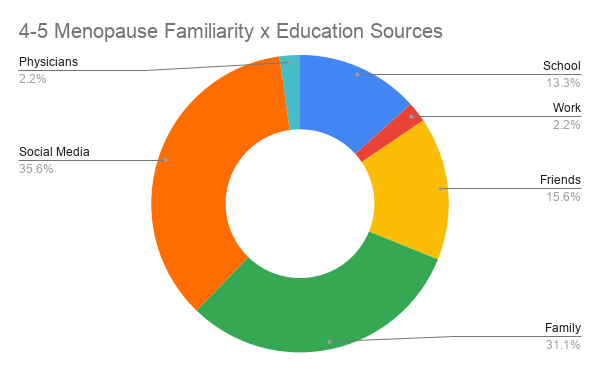
Source: Original survey, 51 responses; women aged 15-60.
Desc: Cross-variable relationship between 4-5 “menopause familiarity” responses (Q5) and their respective educational sources (Q7). Percentages are taken from the 45 total multiple-choice responses of education sources.
Cross-Variable Comparison: “Menopause Communication” vs. Age

Source: Original suvey, 51 survey; women aged 15-60.
Desc: Grouping of menopause communication (with provider(s)) rating with participant age responses. Y-Axis is the percentage of responses from the given age group per response 1 - 5. 1 = Not Relevant, 5 = Very Relevant. Colors correspond by 1-Dark Blue, 2-Orange, 3-Light Blue, 4-Orange, 5-Red.